
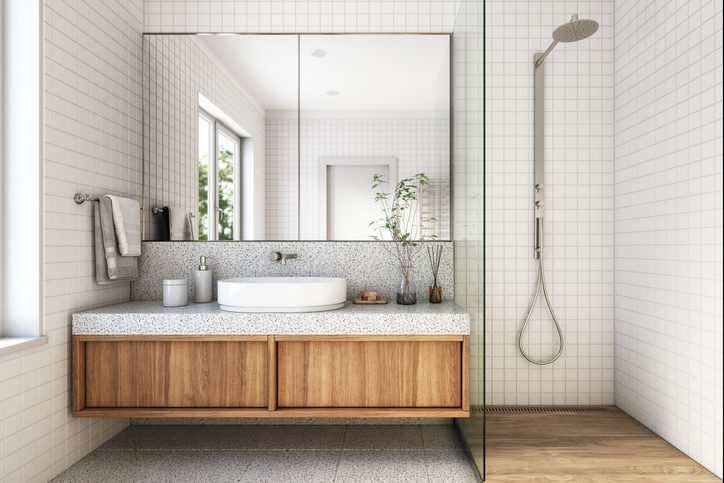
A curbless shower in a small bathroom is a walk-in shower design with no raised threshold or lip at the entry — the floor transitions seamlessly from the bathroom to the shower area. In small bathrooms, this design visually opens the space, improves accessibility, and eliminates the step-over hazard of a traditional shower curb. Installation requires proper slope, waterproofing, and drain placement.
What Is a Curbless Shower and Why Does It Work in Small Bathrooms?
A curbless shower is defined by a continuous floor surface that flows from the main bathroom into the shower zone without a raised barrier. The shower area is contained by precise floor slope — typically a quarter-inch drop per foot — that directs water toward a linear or center drain.
In a small bathroom, the absence of a curb creates a visual continuity that makes the room feel larger. There are no visual breaks in the tile plane, no shadow lines from a threshold, and no bulky shower door frame sitting at eye level. The result is a bathroom that reads as a single cohesive space rather than a cramped room with a box in the corner.
From a practical standpoint, curbless showers are also the ADA-compliant standard for accessible design. Whether or not accessibility is the primary goal, eliminating the step-over hazard is a genuine safety upgrade — particularly relevant in Florida, where ageing-in-place renovation requests are among the most common projects we handle.
How Small Can a Curbless Shower Be in a Small Bathroom?
The minimum functional size for a curbless shower is 36 inches by 36 inches. At that dimension, the space is usable, but anything below 48 inches by 36 inches starts to feel tight for most adults. If your small bathroom allows for 48 by 36 or 60 by 36, you will have a significantly more comfortable experience.
For very small bathrooms — under 50 square feet — a curbless wet room format is worth considering. In a wet room, the entire bathroom floor is waterproofed and sloped to a drain, with the shower area defined by a partial glass screen rather than walls. This approach gives you a functional shower without dedicating a distinct enclosed footprint to it.
The key constraint is not always floor space — it is wall space. You need a minimum of two walls to anchor the shower area, and at least one wall should be solid enough to hold a recessed niche or grab bar without hitting a plumbing stack. A site assessment before you finalise layout decisions saves significant cost downstream.
What Tile and Drain Options Work Best for a Curbless Shower?
Tile selection for a curbless shower must account for slip resistance — the floor tile needs a minimum coefficient of friction (COF) of 0.42 for wet areas, and 0.60 or higher is preferable. Smaller mosaic tiles, textured porcelain, and natural stone with a honed or brushed finish all perform well. Large-format tiles (24×24 or larger) work on the floor if they are installed with proper back-butter technique and achievable slope across fewer grout joints.
The drain choice defines the entire slope geometry of the floor. A center drain requires the floor to slope from all four sides — manageable in a square shower but challenging in a long narrow space. A linear drain positioned at the back wall or along one side wall allows the floor to slope in a single plane, which is simpler to tile and produces cleaner sight lines.
In Florida, we strongly recommend linear drains for small curbless showers. The single-plane slope makes large-format tile installation far more forgiving, and the stainless steel linear drain cover reads as a deliberate design detail rather than a functional compromise.
Getting the drain placement, slope, and waterproofing right in a small curbless shower is where the project either succeeds or fails. At Property Fixology, we scope the subfloor, confirm drain placement, and spec the waterproofing system before a single tile is ordered. Ready to plan your shower? Visit our Shower Remodel page or call us at (407) 885-5935.
What Does Waterproofing a Curbless Shower in Florida Require?
Waterproofing a curbless shower is non-negotiable — and in Florida’s humidity, it is more critical than in a northern climate. Without a curb to contain water, the waterproofing membrane must extend well beyond the shower footprint onto the surrounding floor and at least 6 inches up every adjacent wall.
The two main waterproofing systems used in Florida residential renovations are sheet membranes (such as Schluter Kerdi or Wedi board) and liquid-applied membranes (such as RedGard or Laticrete Hydro Ban). Both perform well when installed correctly. The critical failure points are corners, penetrations (drain collar, shower valve), and the transition between the shower floor and the bathroom floor.
Florida’s building code requires inspections at the rough-in and waterproofing stages for bathroom remodels that involve structural or plumbing changes. A licensed contractor will schedule these inspections as part of the project timeline — not as an afterthought. Skipping the inspection stage is how homeowners end up with mould problems behind tile two years after installation.
How Much Does a Curbless Shower Remodel Cost in Central Florida?
A curbless shower conversion in a small Central Florida bathroom typically costs between $4,500 and $12,000, depending on the scope of work, tile selection, and whether the existing plumbing is being relocated. The core cost drivers are waterproofing system, drain type and placement, tile material and labor, and glass enclosure or screen.
A straightforward swap — removing an existing shower curb, re-sloping the floor, installing a linear drain, and re-tiling the shower area — sits at the lower end of that range, around $4,500 to $6,500. A full wet room conversion with new plumbing rough-in, full bathroom waterproofing, large-format tile throughout, and frameless glass panels runs $9,000 to $14,000 and above.
The most common budget mistake we see is underestimating the waterproofing and subfloor work. If the existing shower pan is failing or the subfloor has moisture damage, that work comes before any tile goes down. A proper site assessment identifies those issues before the project starts, not after demo day.
Frequently Asked Questions About Small Bathroom Curbless Showers
Can you add a curbless shower to a very small bathroom?
Yes — a curbless shower can be installed in bathrooms as small as 36 square feet, depending on layout. A minimum shower footprint of 36 by 36 inches is functional, though 48 by 36 or larger is more comfortable. Wet room designs work well in very small bathrooms where a distinct enclosed shower area is not practical.
What is the best drain type for a curbless shower in a small bathroom?
A linear drain positioned at the back wall or along one side wall is the best choice for most small curbless showers. It allows the floor to slope in a single plane toward one wall, which simplifies tile installation and produces cleaner sight lines than a center drain, which requires the floor to slope from all four sides.
Does a curbless shower need a special waterproofing system in Florida?
Yes. In Florida’s climate, curbless showers require a continuous waterproofing membrane that extends beyond the shower footprint onto the surrounding floor and at least 6 inches up adjacent walls. Both sheet membranes (Schluter Kerdi, Wedi) and liquid-applied membranes (RedGard, Laticrete Hydro Ban) perform well when installed by a licensed contractor.
How much does a curbless shower conversion cost in Central Florida?
A curbless shower conversion in Central Florida typically costs $4,500 to $12,000 for a small bathroom. A basic curb removal, re-slope, linear drain, and re-tile sits at $4,500 to $6,500. A full wet room conversion with new plumbing rough-in, full waterproofing, and frameless glass panels runs $9,000 to $14,000 and above.
Do I need a permit for a curbless shower remodel in Orlando?
In most Orange County and Central Florida municipalities, a shower remodel that involves moving or modifying plumbing requires a permit. A licensed contractor will pull the permit on your behalf. Work that replaces tile and fixtures in the same location without moving plumbing may fall below the permit threshold — your contractor can confirm based on your specific project scope.
Ready to build a curbless shower that actually works — properly waterproofed, correctly sloped, and finished to last? Property Fixology’s Shower Remodel service handles every stage — subfloor prep, waterproofing, drain, tile, and glass. Get a free estimate — we’ll assess your bathroom and give you a clear scope before any work begins. Call us: (407) 885-5935.